

LIVING CLIMATE FUTURES SYMPOSIUM 2026
LIVING CLIMATE FUTURES SYMPOSIUM 2026
Save the date: April 23-25, 2026
The symposium brings together community environmental organizations with MIT researchers and students to explore how climate change – and responses to it – are playing out in locations from New England to the Pacific Northwest to Mongolia. Topics include localized health and ecological effects, food systems, energy transitions, and how to further collaborative and interdisciplinary climate research. Register here.
is an interdisciplinary initiative bringing together twenty MIT faculty and affiliates from across the Institute. LCF was the recipient of the inaugural Faculty Driven Initiative (FDI) Seed Grant from the MIT Human Insight Collaborative (MITHIC) in spring 2025.
Living Climate Futures (LCF)

More about LCF members on our page
LIVING
CLIMATE
FUTURES
SYMPOSIUM II
April 23-25, 2026
LIVING CLIMATE FUTURES SYMPOSIUM II
MIT Campus | Registration
The symposium brings together community environmental organizations with MIT researchers and students to explore how climate change – and responses to it – are playing out in locations from New England to the Pacific Northwest to Mongolia. Topics include localized health and ecological effects, food systems, energy transitions, and how to further collaborative and interdisciplinary climate research.
Program subject to change. Speaker list coming soon.
Symposium Pre-event
Saturday April 18th
10:00 am – 3:00 pm Honor the Earth Festival on Cape Cod
Symposium Events
Thursday April 23
5:00 pm Writing to Inspire Change: Strategies for Public Engagement
6:30 pm Film screening and Q&A, If Only I Could Hibernate
Friday April 24
9:00-9:30 am Welcome
9:30-10:45 am Taking Stock in Contentious Times
11:00 am - 12:30 pm Data Centers, Climate, and Community Health
2:30 - 4:00 pm Food and Climate Ecologies: Bringing together growers, processors, and distributors in New England
4:15 - 5:45 pm The Work of Repair
6:30 - 8:30 pm Climate Change as Place-Based Phenomena: Perspectives on Mongolian grasslands pastoralism, Diné desert ecologies, and post-industrial wetland environments in Chicago
Saturday April 25
9:00 am-12:00 pm Field trips:
The Food Project (Roxbury)
Living Lab Tour (Boston Harbor)
Degrowth & Energy Metabolism of MIT campus (on campus)
2:30 - 4:00 pm Climate Chaos and Indigenous Spiritual Sovereignty: Perspectives from Se’Si’Le & Children of the Setting Sun
4:15 - 5:45 pm Experiential Learning, “Anthro-Engineering,” and Learning to Do Community-Oriented Research
7:00 - 8:30 pm Film screening Climate Voices. Q&A w. dir. Leslie Jonas
Living Climate Futures
Spring 2022 — and beyond
History, Anthropology & STS Massachusetts Institute of Technology

Protest sign from Southeast Chicago.
The effects of climate change are all around us, but unevenly. Science and engineering provide essential tools for assessing and helping to mitigate earth systems changes underway, but those changes also result from political-economic decisions and neglect that perpetuate social inequities and injustices. Thus, as MIT’s Fast Forward Climate Plan recognizes, “the world will not solve the climate problem without solving the intertwined problems of equity and economic transition.”

U.S. Secretary of the Interior Deb Haaland accepting the Sacred Lands totem pole on a journey to Washington, D.C. co-sponsored by Se'Si'Le in summer 2021.

Our Inaugural Lecture:
“Unfracking the Future Through Relational Redesign”
Speaker: Sara Wylie, Ph.D. MIT HASTS
Discussant: Marc G. Weisskopf, Ph.D., Sc.D.
November 6th, 4:30pm-6pm
E51-376, Tang Center
Living Climate Futures demonstrates a collaborative approach that does not merely ask after the “social impacts” of climate change and mitigation strategies on diverse communities, but instead is led by research agendas that center community needs, experiences, and priorities.
“Climate change” does not happen alone. It is always bound up with other things: land dispossession, eroding infrastructure, industrial pollution, job loss, water and food insecurity, racial discrimination, and more. This is particularly true for Indigenous/Native peoples and disenfranchised communities. Living with climate change means grappling with deteriorating economic and environmental conditions in the present, while planning for an uncertain future.
The Living Climate Futures Initiative is attentive to historic inequalities including the legacies of settler colonialism and slavery, as we move forward by sharing notes for creative solutions.

Professor Ryan Emanuel (Lumbee), speaking to a group from the North Carolina Department of Environmental Quality about wastewater contamination. Photo by David Shane Lowry.
Friday - Saturday
22 - 23 April 2022
—
Public Symposium
MIT - Cambridge, MA
Participating groups:
Southeast Environmental Task Force (Chicago, IL), Se’Si’Le (Bellingham, WA), Richland Gro-Op (Mansfield, OH), Lumbee Community (North Carolina), GreenRoots (Boston, MA), and more.
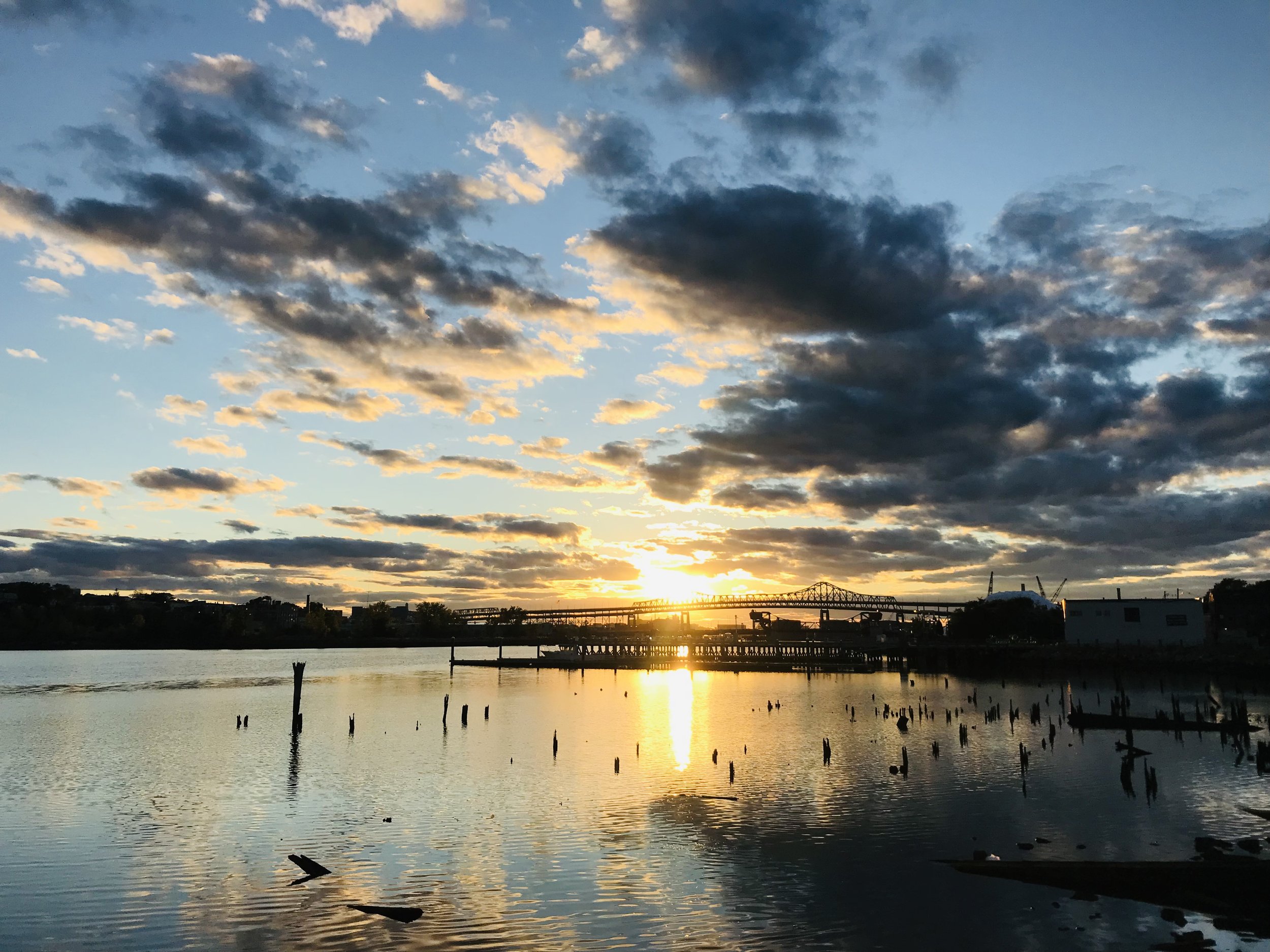
A view onto Chelsea Creek looking toward the Boston Bay Marina. Photo by Bettina Stoetzer.
Meet front-line climate and environmental justice activists from across the country. Visit (via live remote) with high school activists in Southeast Chicago. Take a guided environmental or food justice tour of Chelsea or Roxbury. Hear the experiences of our community partners and participate in an exercise to envision livable climate futures for all!